


Blog


Cloud Insights
Real-world insights on cloud hosting, managed services, cybersecurity, and scaling your IT with confidence.

Cloud ERP Hosting
22 Aug 2023
Navigating Acceptable Risk – Is Your On-Premises Sage ERP Worth the Risk?
In business, the path to success is often paved with calculated risks, bold decisions, and the willingness to embrace the unknown. But as every seasoned business owner knows, not all risks are equal. While some risks propel growth, others can hinder progress, particularly those associated with sticking to the status quo. Every small to mid-sized business grappling with an on-premises ERP system should ask: How much risk are you willing to take, and more importantly, do you fully understand the consequences? Is clinging to the status quo of your Sage system a gamble you’re willing to make? And ultimately: What is your acceptable level of risk?
The Hidden Risks of On-Premises Sage ERP
As technology evolves, so too should your measure of acceptable risk. On-premises Sage accounting/ERP systems once stood as the pinnacle of security and control. However, as technology has evolved, so have the risks associated with maintaining these systems. Here’s how the perceived safety of on-premises ERP can deceive you:
Security Vulnerabilities
Older systems often lack the agility to adapt to emerging cyber threats. Patching and updating become increasingly complex, leaving your business exposed to potential breaches.
Compliance Challenges
Modern compliance mandates like SOC and MFA require technological changes, continuous updates, and ongoing monitoring. It is becoming increasingly difficult (and costly) for on-premises ERP systems to adapt.
Cost Burden
Maintaining, securing, and updating an on-premises system can be financially draining, diverting resources from innovation and growth.
Understanding Acceptable Risk
In the context of your Sage ERP, we’re using the term acceptable risk to refer to the level of risk you are willing to tolerate by not migrating to a more secure and flexible private cloud hosting model. This requires your organization to perform a careful examination of:
Potential Threats
Are you aware of the security threats that your current system is exposed to? Are you adequately investing in the technology tools and expertise required to protect you from those threats? Are you comfortable with the risks associated with your system’s vulnerabilities?
Compliance Readiness
Can your existing system adapt to new compliance mandates like SOC, SOX, MFA, HIPAA, and CCPA without significant time and financial investments?
Business Impact
How would a security breach or compliance violation affect your business reputation, operations, and bottom line?
Mitigating the Risks With the Private Cloud Hosting Model
Moving to a private cloud hosting model is an effective way for businesses to mitigate the risks associated with Sage ERP while continuing to leverage the legacy and ongoing investments they’re making in those applications.
Transitioning to private cloud hosting uses a “lift and shift” approach. Lift and shift is a strategy used in information technology, particularly in cloud migration. It refers to moving an application or operation from one environment to another without modifying its design, architecture, or functions.
Here’s a high-level look at what the lift and shift process entails:
Lift: This part of the process involves taking the existing applications, data, and operations from the current environment, whether it’s an on-premises data center or even another cloud provider. This is done without changing the code, structure, or architecture.
Shift: This involves relocating the lifted applications, data, and operations to a new environment, such as a private (or public) cloud. Again, this is done without modifying or optimizing the applications for the new environment.
The lift and shift approach can be an attractive option for organizations looking to quickly move to the cloud or another environment, as it typically requires less time, effort, and cost than replacing the applications. Businesses often use it as a first step in a larger cloud migration strategy.
Moving your Sage ERP and other critical business applications from an on-premises server to a private cloud hosting provides is not about abandoning the familiar — it’s about embracing a future that offers:
Enhanced Security
Private cloud providers specialize in combating the latest cyber threats, ensuring your data remains secure.
Compliance Agility
Cloud-based ERP enables you to adapt quickly to new regulatory requirements, minimizing the risk of non-compliance.
Scalability and Flexibility
Private cloud hosting accelerates your ability to incorporate additional applications and productivity tools that help your business scale and adapt, ensuring your technology never holds you back.
How Much Risk Are You Willing to Accept?
Remaining with an on-premises ERP system presents some clear —and some hidden — risks and limitations. It’s a decision that requires you to honestly evaluate how much risk is acceptable for your business.
Are you willing to accept the security vulnerabilities? The compliance challenges? The potential cost burden? The time to ask these questions is now. Transitioning to a private cloud hosting model is a strategic and surprisingly simple move that aligns with modern business demands, offering enhanced security, compliance, and flexibility.
Don’t let acceptable risk turn into unacceptable consequences. Explore the opportunities private cloud hosting offers and position your business for a future defined not by limitations but by possibilities. Virtual private cloud hosting of your Sage ERP application can mitigate many risks, allowing you to continue growing and scaling your business while maximizing your software investment. Learn more about Sage Cloud Hosting by contacting a member of our cloud services team.
Read more

Private Cloud Hosting
14 Jun 2023
The Hybrid Work Enabler: Virtually Everything You Need To Know About Virtual Desktop Infrastructure
The hybrid workplace is here to stay. A recent McKinsey survey found that 86% of organizations expect remote work to increase (53%) or remain unchanged (33%). For companies large and small, this evolution requires investments in technologies that facilitate seamless collaboration, productivity, and security—which is where virtual desktops come into play. While the terms virtual desktop and virtual desktop infrastructure (VDI) are familiar, it’s helpful to consider them again in the context of the rise of the hybrid workforce. What is VDI, and how can Microsoft Azure Virtual Desktop help your organization enable, secure, and optimize its hybrid work model?
TMI on VDI
Virtual desktop infrastructure (VDI) software allows you to configure and manage virtual desktops hosted on-premises—or in the cloud. The desktops run on virtual machines located on servers in a data center (such as Cloud at Work’s) instead of the actual desktop/laptop hardware. A “virtual image” of the user’s desktop is sent over the network to the remote user, allowing them to access the desktop image as if it were rendered locally. Microsoft Azure Virtual Desktop is perhaps the most commonly used VDI.
Here’s a simple way to think about VDI. Think about your computer or laptop at your home or work. It has your operating system (like Windows), files, and applications (like Word, Excel, etc.) stored in it, right? Now, imagine if, instead of being tied to just one physical device, you could access your entire computer – with all its files and applications – from anywhere, on any device. That’s essentially what Microsoft Azure Virtual Desktop does.
Azure Virtual Desktop creates a version of your computer that lives in Microsoft’s secure cloud instead of on a physical device. You can access it through the internet on any device, including a laptop, tablet, or smartphone. This means, for example, you could start a report on your computer at work, continue working on it from your home computer, and even make final edits from your tablet while on the move. Your work is always there, updated, and saved, regardless of your device. Essentially, when you’re using VDI, your devices function as a keyboard and screen—the cloud is doing the heavy lifting.
Furthermore, because the virtual desktop is hosted in the cloud, it is protected by robust security measures. The organization’s data remains safe even if your laptop or phone is lost or stolen.
It Matters Where Your Data Lives
Employee workstations, with corporate programs and data held locally, pose an enormous security risk to your organization. VDI mitigates those risks in several ways by centralizing data and programs in a controlled environment.
Data Security
With VDI, data is stored centrally in secure data centers instead of being held locally on individual workstations. This reduces the risk of data breaches since sensitive information is not directly accessible from the endpoint devices. Even if a device is lost, stolen, or compromised, the data remains secure since it is not stored on the physical device.
Enhanced Access Controls
VDI allows for centralized access control and user authentication. Your IT administrators can define strict access policies, implement multi-factor authentication, and enforce granular permissions to ensure only authorized users can access the virtual desktop environment. This helps mitigate the risk of unauthorized access to sensitive data.
Reduced Malware Exposure
Since the virtual desktops are hosted in a centralized environment, your employees interact with the desktop through remote protocols or thin clients. This reduces the risk of malware infections on individual workstations. Even if a user accidentally encounters malware while browsing the internet or opening suspicious files, the impact is limited to the virtual desktop session, and the underlying infrastructure remains protected.
Centralized Management and Control
VDI enables centralized management and control of the virtual desktop infrastructure. IT administrators (or your cloud services provider) can easily enforce security policies, apply software updates, and simultaneously deploy security patches across all virtual desktops. This ensures consistency and reduces the chances of security vulnerabilities caused by inconsistent configurations.
Disaster Recovery and Business Continuity
Azure Virtual Desktop provides built-in backup and disaster recovery mechanisms. Your MSP or cloud services provider performs regular backups of the virtual desktops and associated data, ensuring that your critical information is protected and can be restored in the event of hardware failure, natural disasters, or other unforeseen circumstances.
Minimized Insider Threats
Not all threats are external. VDI helps mitigate insider threats by providing enhanced monitoring and auditing capabilities. You can track user activity, monitor access to sensitive data, and enforce data loss prevention (DLP) measures. In the event of suspicious or unauthorized behavior, administrators can quickly revoke access or take appropriate action to prevent data breaches or misuse.
In short, VDI provides a more secure environment for your organization’s data and programs by centralizing them, enabling stricter access controls, reducing exposure to malware, and facilitating centralized management and monitoring. These factors combine to improve security, data protection, and risk mitigation.
The hybrid work model is gaining steam, and technologies like Microsoft Virtual Desktop accelerate this transformation by enabling flexibility, facilitating collaboration, and boosting security. As your business adapts to the changing work models, the role of such technology becomes even more critical. Learn more about Microsoft Azure Virtual Desktop solutions by contacting a member of our cloud services team.
Read more

Cloud ERP Hosting
Private Cloud Hosting
01 Jun 2023
A New ERA for ERP Why Private Cloud Hosting Is The Best Next Solution To Maximize Your Sage ERP ROI
A new paradigm is emerging as forward-thinking businesses consider private cloud hosting a more effective option.
Your Sage ERP application plays an essential role in managing core business processes. Still, as technology advances and your business needs evolve, the traditional on-premises deployment creates roadblocks in meeting the demands of your modern organization. For example, remote access barriers, costly server maintenance, and limited scalability are common challenges with on-premises applications. It may feel like you have two options—keep doing what you’re doing or migrate to a cloud-based next generation ERP application—and neither option feels right.
A third option is available—one that combines the best of both. It’s Sage virtual private cloud hosting—an innovative approach that ushers in a new era for Sage ERP customers. This approach offers the perfect blend of security, scalability, and flexibility, making it an ideal option for modernizing your organization’s ERP infrastructure while continuing to leverage the value proposition you’ve spent years building. Think of it as the cloud on your terms.
What are the distinct advantages of private cloud hosting for Sage ERP users? What will your ERP future look like? How confident are you in your plans for business continuity, cybersecurity protections, and compliance mandates? How do you make the move to a private cloud? We’ll address and answer these questions and more in an upcoming series of articles highlighting Sage in the Cloud. But before we get there, let’s start at the beginning—what is private cloud hosting, what makes it different from public cloud hosting, and what makes it the best option for Sage ERP users?
What is private cloud hosting?
Private cloud hosting refers to a cloud computing model where dedicated cloud infrastructure is used exclusively by a single organization. In a private cloud environment, the infrastructure, including servers, storage, and networking resources, is designed and managed specifically for your organization’s use.
While individual companies can establish and host their own private clouds, small to medium-sized enterprises typically partner with a virtual private cloud service provider to provide the necessary physical and virtual infrastructure. Some private cloud hosts specialize in specific sectors. Cloud at Work, for example, specializes in hosting Sage ERP and companion applications. Many also offer additional, value-added services, such as hosting Microsoft Exchange.
How’s it different from public cloud hosting?
Virtual private cloud hosting differs from public cloud hosting in several key ways.
A virtual private cloud is a cloud environment located within a public cloud. In a private cloud, services and infrastructure are hosted off-site, just like in public cloud hosting. However, with private cloud providers, users receive their own private section within the public cloud that is isolated from other users and managed by the provider. Some private cloud providers specialize in specific industries or niche markets. Cloud at Work, for example, specializes in hosting Sage ERP and complementary applications.
The private cloud environment allows for a higher level of security and privacy compared to a public cloud because you are not sharing resources with other users. Also, you get a certain level of control over your network settings, similar to operating your own private data center, but without the hassle of maintaining the infrastructure.
On the other hand, public cloud hosting is a service where a provider (think AWS and Google Cloud) makes resources, such as applications, storage, and virtual machines, available to the general public over the internet. These resources are shared among multiple users (also known as multi-tenancy), and you have less control over your data and how it’s stored and secured. In addition, small and medium-sized businesses like yours do not deal directly with a public cloud host. Instead, you’ll work through several layers, including a managed services provider, none of which understands your Sage application.
Why should I consider private cloud hosting for Sage ERP?
You can unlock many benefits by shifting your Sage ERP system to a private cloud environment, including:
Scalability and flexibility: On-premises ERP systems are notorious for their limited scalability, making it challenging for businesses to accommodate growth or sudden surges in demand. Private cloud hosting enables organizations to scale their ERP infrastructure (up and down) effortlessly, ensuring you can adapt to changing business needs without disrupting operations.
Enhanced security and data protection: On-premises ERP systems require you to invest heavily in robust security measures and regularly update them to counter evolving cyber threats. By leveraging private cloud hosting, you gain access to dedicated security professionals, cutting-edge encryption protocols, and proactive monitoring, ensuring your critical data remains safe and protected.
Improved accessibility and collaboration: With an on-premises ERP system, accessibility to remote employees or business locations is challenging. With private cloud hosting, employees can access your Sage ERP applications and data from anywhere, using a range of devices.
Business continuity and disaster recovery: Unforeseen events such as natural disasters, power outages, or hardware failures can severely impact on-premises ERP systems, leading to costly downtime and even data loss. Private cloud hosting ensures data redundancy, backup solutions, and disaster recovery mechanisms, safeguarding your business against disruptions and minimizing downtime.
Maintenance and updates: In private cloud hosting, your managed service provider or the hosting provider take responsibility for infrastructure maintenance and updates, reducing the burden on your organization’s IT staff. And importantly—you can control when (and even if) your Sage ERP software is updated.
Future-proofing your business
For decades, on-premises ERP systems have been the go-to solution for businesses, offering a sense of control and familiarity. However, as technology advances and the demands of the business environment intensify, traditional on-premises ERP systems are revealing their limitations. Virtual private cloud hosting of your Sage ERP application can overcome many of these limitations, allowing you to continue growing and scaling your business while maximizing your software investment. Learn more about Sage Cloud Hosting by contacting a member of our cloud services team.
Read more
Cloud ERP Hosting
News
01 May 2023
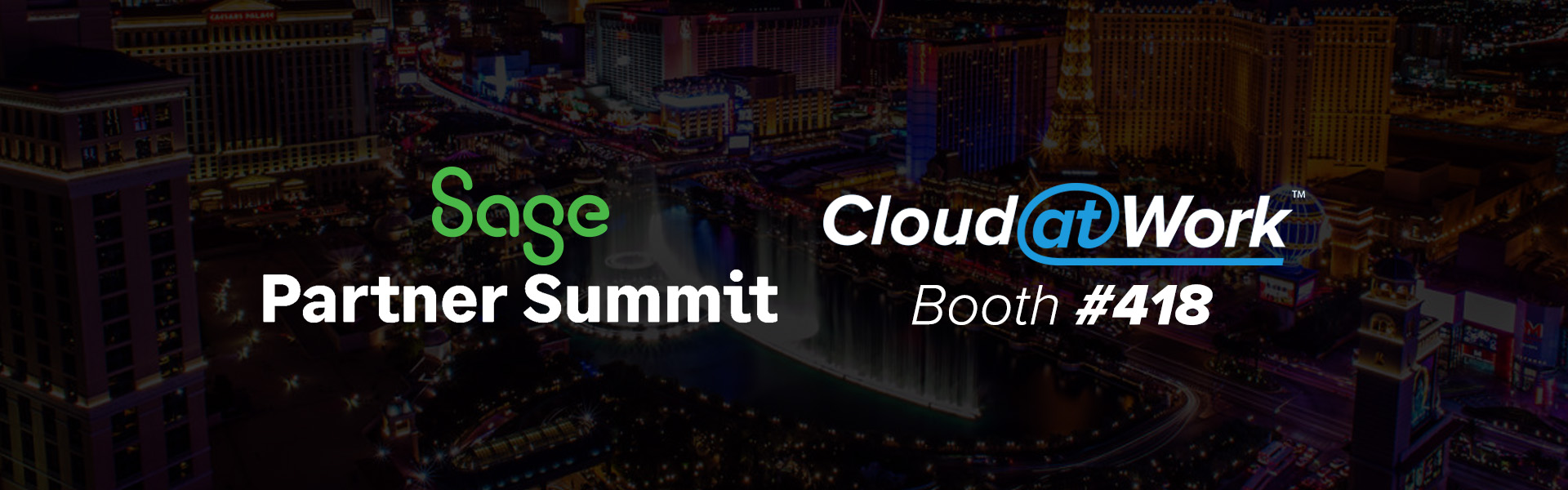
Sage Partner Summit 2023
We are excited to be a Platinum Sponsor of the sold-out Sage Partner Summit 2023, and look forward to greeting all our partners, and future partners in Las Vegas. For those attending please be sure to visit our team at booth #418 for updates on the Cloud at Work partner program and our service offerings.
We also invite you to join the Cloud at Work team for an unforgettable evening of fun, networking, and entertainment at Summit After Dark at Top Golf Las Vegas!
Co-sponsored by Cloud at Work, along with some of our key strategic partners, this is the perfect opportunity to unwind and connect after a long day of learning and growth at Sage Partner Summit. We hope you can make it! Details and registration info is below.
What: Sage Partner Summit After Dark at Top Golf Las Vegas!
Date: Monday, May 22 | 8 – 11pm PDT
Location: Topgolf | 4627 Koval Lane, Las Vegas, NV 89109
Register Here: https://www.eventbrite.com/e/summit-after-dark-tickets-619110725847
This Event is Complimentary. Space is Limited. Food and beverages will be provided at the event.
Read more

Cloud ERP Hosting
08 Jun 2022
Cloud at Work Partners with Sage Canada as Strategic Cloud Hosting Provider; Launches Toronto-based Data Center
Sage partnership will accelerate expansion of Cloud at Work’s Canadian customer base; company builds new data center in Toronto to give Canadian customers robust data security, assured application uptime and data compliance.
NEW YORK, NY – June 8, 2022 – Cloud at Work (www.thecloudatwork.com ), a purpose-built Sage hosting solution, today announced it has been named by Sage Canada as an approved Strategic Hosting Provider to help Sage Partners migrate Canadian customers to the cloud. Cloud at Work allows Sage customers who are currently using on-premises solutions, including Sage X3, Sage 100, Sage 300, and Sage CRE, to realize the increased performance, efficiencies and financial benefits of SaaS, with the Sage support and SaaS expertise of the Cloud at Work team.
A new state-of-the-art data center based in Toronto adds to Cloud at Work’s two data centers based in the U.S., and gives Canadian customers robust data security, assured application uptime, and data compliance for those required to house their data in-country.
“Cloud at Work’s new data center will better serve our customers with Canadian data residency needs”
-Daniel Oh, Country Manager (interim), Sage Canada.
“Today’s announcement is recognition of Cloud at Work’s hard-won reputation for providing Sage customers across the U.S. with a world-class cloud experience, and Sage’s trust in our ability to deliver the same high level of performance for their customers across Canada,” said Tyler Bower, Director of Cloud and Hosting at Cloud at Work. “Building the data center in Toronto demonstrates our investment in and commitment to our Canadian customers, in meeting the demand for a robust, reliable, compliant hosting environment that unleashes the power of their business.”
“Cloud at Work has a proven track record in providing our U.S. customers with reliable, secure, high-performance cloud hosting, which is why our Canadian customers should be delighted with today’s news,” said Daniel Oh, Country Manager (interim), Sage Canada. “With their SaaS knowledge and Sage product expertise, Cloud at Work’s new data center will better serve our customers with Canadian data residency needs. We look forward to the Cloud at Work team continuing to support our Canadian customers and helping them adapt to change, smoothly migrating their Sage applications to the cloud, and giving them the agility needed to succeed in today’s challenging business environment.”
Cloud at Work offers secure, scalable technology and a great user experience via an experienced Sage team in North America and works seamlessly with Sage Business Partners to fast-track best-in-class cloud solutions that fit specific needs and improve business processes.
Cloud at Work recently received Sage’s accreditation as a Sage X3 Strategic Hosting Provider, adding to previous accreditation as a Sage 100, Sage 300, and Sage CRE Strategic Hosting Provider, validating the strength of the company’s SaaS and Sage application expertise. Cloud at Work’s recent SOC 2 certification assures customers of maximum data security and business continuity, further demonstrating the company’s commitment to client trust and care in helping unleash the power of their business.
About Cloud at Work
Cloud at Work gives users of Sage applications more capabilities and control to increase business performance using their technology investments. With a knowledgeable, highly responsive team of Sage application experts and advanced cloud hosting solutions personalized to customer strengths, Cloud at Work helps its customers pivot more quickly to capitalize on new business opportunities and resolve issues faster. Businesses using Sage trust Cloud at Work to help them achieve higher levels of business productivity and resiliency that outpace competitors and help them capture more market share. Visit thecloudatwork.com for more information.
Read more

News
03 May 2022
Cloud at Work Announces Sage’s Accreditation as Sage X3 Strategic Cloud Hosting Provider
Adds to Cloud at Work’s previous accreditation as Sage 100, Sage 300, and Sage CRE Strategic Hosting Provider, validating the strength of the company’s SaaS and Sage application expertise in providing customers with a world-class cloud experience.
NEW YORK, NY – May 3, 2022 – Cloud at Work, a purpose-built Sage hosting solution, today announced that it has been accredited by Sage as an approved Sage X3 Strategic Hosting Partner. Cloud at Work allows Sage customers who are currently using on-premises solutions, including Sage X3, Sage 100, Sage 300, and Sage CRE, to realize the increased performance, efficiencies and financial benefits of SaaS, with the Sage support and SaaS expertise of the Cloud at Work team.
“Today’s announcement provides further reinforcement of Sage’s trust in Cloud at Work’s ability to support Sage partners and customers in providing a world-class cloud experience for their Sage applications,” said Tyler Bower, Director of Cloud and Hosting at Cloud at Work. “The Sage-Cloud at Work partnership meets the growing demand for flexible, fast and safe migration to a reliable hosting environment, giving organizations the agility they need to compete in today’s rapidly changing business landscape, unleashing the power of their business.”
Cloud at Work was previously selected by Sage as an Accredited Cloud Hosting Provider for Sage 100, 300 and CRE applications, based on their Sage application expertise and proven ability to provide Sage customers with a hosted environment that provides optimal flexibility and reliably high-level performance. Cloud at Work’s recent SOC 2 certification assures customers of maximum data security and business continuity, further demonstrating the company’s commitment to client trust and care in helping unleash the power of their business.
About Cloud at Work
Cloud at Work gives users of Sage applications more capabilities and control to increase business performance using their technology investments. With a knowledgeable, highly responsive team of Sage application experts and advanced cloud hosting solutions personalized to customer strengths, Cloud at Work helps its customers pivot more quickly to capitalize on new business opportunities and resolve issues faster. Businesses using Sage trust Cloud at Work to help them achieve higher levels of business productivity and resiliency that outpace competitors and help them capture more market share. Visit thecloudatwork.com for more information.
Read more

Cloud ERP Hosting
13 Apr 2022
The Cloud Wave: An SMB Imperative
Risk 5: The Workforce is Forever Changed
Risk 5: The Workforce is Forever Changed
By now we’ve all heard of “the great resignation,” and while that certainly creates a challenge for employers, it’s far from the only employment-related challenge facing small and midsized businesses (SMBs). There’s also the fact that baby boomers are retiring and the key positions they held will be filled with a younger generation with decidedly different expectations from their employers. In addition, when employees leave, they often try to take company data with them, creating real security concerns. It’s a brave new workforce world out there, and SMBs who don’t or can’t adapt will be left behind.
A changing workforce is Risk #5 in our series highlighting five areas of your operation at risk if you maintain the status quo. How can cloud hosting help SMBs navigate the new employment landscape, turning challenges into opportunities?
The Great Resignation is compounded by the Silver Tsunami
You’ve no doubt heard the term “The Great Resignation.” The popular phrase refers to the roughly 33 million Americans who have quit their jobs since the spring of 2021. Some of these are older workers who decided to retire early. Others are secondary earners leaving the job market to care for children who were home from school. Likely most of those quitting were simply in search for better pay, perks, and flexibility. Now, adding to the exodus is a “Silver Tsunami” of Baby Boomers leaving the workforce. A recent survey from Coventry showed that over 75% of the respondents said they plan to retire early.
The wave of resignations and retirements leaves SMBs with gaps in their workforce. And those gaps are being filled by a younger generation who have vastly different plans for their career paths, and very different expectations from their employers. Gen Z and millennials now comprise nearly half the US workforce, making them a (work)force to be reckoned with.
Attracting and retaining this talent requires SMBs to adopt a new mindset. It requires SMBs to digitally transform themselves from Takeoff companies to Destination companies.
Are you a Destination or a Takeoff company?
Millennials are digital natives — they grew up with technology and the internet. These are the children of Baby Boomers. Fortune magazine calls 1995 (millennials were born between xx and 1996) “The Year Everything Changed.” Internet technology powerhouses like Amazon, eBay, and Match.com got their start in 1995. This may be all you need to know about millennials — they’ve never known a world without Amazon.
Technology is completely integrated into the everyday life of millennials. They do not ask for sufficient technology at their jobs — they expect it. To their credit, the expectation doesn’t come from a sense of entitlement — what millennials really want are the tools they need to do their job efficiently. Employers seen as technology laggards simply can’t compete for this segment of the workforce. Offering higher and higher salaries may initially attract them, but they will quickly takeoff.
Unless SMBs invest in their technology infrastructures and business management applications, they will forever be Takeoff companies while their competitors who have embraced cloud technologies will be the Destination.
Technology laggards are vulnerable to data loss
Attracting and retaining new talent is more challenging for technology laggards. If that weren’t enough, these companies are also in a more precarious position regarding data security.
When employees leave, they take company data with them. In the last 30 days of employment, upload three-time more data to personal apps. Specifically, Google Drive and Microsoft OneDrive instances are the most popular targets. The trend has most certainly accelerated as employees work in the relative privacy of their homes.
Tech-savvy companies who have invested in robust, cloud-based security controls, can prevent data loss before it starts.
Cloud is a recruiting, retention, and engagement tool
The workforce is forever changed. Even if a majority of employees ultimately return to the office, the status quo of two years ago no longer flies. Companies must transform themselves into places the next generation of employees want to work. Investing in cloud technologies, including cloud hosting, is a definitive step SMBs can take to recruit, retain, and engage these tech-savvy professionals. By arming this generation with the best tools, your SMB not only becomes an employment destination, but it also becomes a business with the tools necessary to grow, scale, and compete.
Read more

Cloud ERP Hosting
29 Mar 2022
The Cloud Wave: An SMB Imperative
Risk 4: Technology Inflation Is a One-Way Street
Risk 4: Technology Inflation Is a One-Way Street
Heard of Moore’s Law? It’s a rule stemming from a 1965 forecast by Gordon Moore that predicts the number of transistors on a chip doubles every two years. The rule helped explain the trend we long witnessed, that as technology products get better and faster, their production costs go down. The rule held for decades, and as a result, technology products have generally had a “deflationary effect.” Well, move over Moore and make room for Murphy. Computer prices are bad now, and they’re likely to get worse.
Inflation is Risk #4 in our series highlighting five areas of your operation at risk if you maintain the status quo. How can cloud hosting help mitigate the effects of inflation?
The “I” word
Inflation surged 7.5% in January 2022, the single biggest increase since February 1982. Costs jumped across nearly all categories — including computer equipment, one sector that has historically been untouched by inflation. For decades we saw the prices of computers and consumer electronics trend down — way down. From December 1997 to August 2015, the Consumer Price Index for personal computers and peripheral equipment declined 96%. Low prices were largely fueled by gains in manufacturing efficiency and automation, lower offshore labor costs, and improvements in semiconductor design (remember Moore?).
My how things can change. The average selling prices of PC are up 10% compared to a year ago. Chip prices alone are up 25% — if you can get one. And the expectation is that prices may go up by another 20% in 2022.
Server prices are following the same trend. AMD, a semiconductor manufacturer specializing in high-performance server equipment, is raising prices on data center processors by 10% to 30%, with smaller customers seeing the largest increases. And backlogs are long and getting longer. Shortages of the components used in server production are expected to last through mid-2023 at least.
Seeing that chips are the lifeblood of modern society, many pundits predict that even if inflation rates decline, the days of inexpensive technology is gone. With virtually limitless demand, there’s little incentive to drop pricing even when production rates increase.
How cloud can help
Moving to a hosted cloud model means a business needs fewer (if any) servers. Sure, they’ll still need workstations and laptops, but the big, expensive, backordered servers are now someone else’s responsibility. It might sound too simplistic to simply say that when you buy less of something, you save money, but for cloud hosting, it’s mostly true. In most cloud hosting models, you no longer need to buy servers. Instead, you’re renting space on a big, powerful server, essentially sharing the cost of the resource with other like-minded businesses.
Cloud hosting provides another tangible, cost-saving benefit for growing companies — it’s enormously scalable. If a business outgrows its in-house server, it risks downtime, performance deterioration, and even lost revenue until it can buy, install, and configure a new, more powerful server. If the same business uses a hosted cloud provider, they simply pay for additional the resources they need. No downtime. No waiting.
It seems inevitable that technology inflation is a one-way street and costs will continue to rise. A move to cloud hosting can keep business flowing both ways, future-proofing your business by ensuring the technology you rely on is always on, always secure, and always at your service.
Read more

Cloud ERP Hosting
News
24 Mar 2022
Cloud at Work Receives SOC 2 Certification, Assuring Customers of Maximum Data Security and Business Continuity
Cloud at Work successfully completes SOC 2 Type 2 certification, a rigorous process that audits privacy, confidentiality, security, availability, and processing integrity; validates company’s commitment to client trust and care
NEW YORK, NY – March 24, 2022 – Cloud at Work, a purpose-built Sage hosting solution, today announced that it has received SOC 2 Certification, which allows their clients to have complete confidence in the security, integrity and availability of their data, assuring business continuity and improved operational efficiencies. The SOC 2 reporting framework, created by AICPA sets benchmarks for managing user data, and is based on Trust Services Criteria: privacy, confidentiality, security, availability, and processing integrity.
Cloud at Work enlisted a third-party accounting firm to conduct a nine-month audit to validate that its platform has the controls in place to achieve SOC 2 certification. Achieving certification on all five Trust Services Criteria further enhances Cloud at Work’s ability to support Sage customers with a world-class cloud experience, from fast, painless deployment to uninterrupted access and reliable performance.
“We knew the SOC 2 certification was going to be an intensive, time-consuming process, but it’s a further demonstration of our commitment to providing Sage users with the industry’s most secure, high-performance cloud platform,” said Tyler Bower, Director of Cloud and Hosting at Cloud at Work “Our number one priority is ensuring the security, integrity and availability of our clients’ data. It’s the foundation of our core value proposition: combining a robust cloud infrastructure with unmatched support and expertise that enables our clients to realize the increased performance, efficiencies and financial benefits of SaaS.”
About Cloud at Work
Cloud at Work gives users of Sage applications more capabilities and control to increase business performance using their technology investments. With a knowledgeable, highly responsive team of Sage application experts and advanced cloud hosting solutions personalized to customer strengths, Cloud at Work helps its customers pivot more quickly to capitalize on new business opportunities and resolve issues faster. Businesses using Sage trust Cloud at Work to help them achieve higher levels of business productivity and resiliency that outpace competitors and help them capture more market share. Visit thecloudatwork.com for more information.
@media (max-width: 500px) {.hero-internal-page { background: url('https://www.thecloudatwork.com/wp-content/uploads/2022/03/bg-aicpa-post-mobile.jpg') no-repeat !important; background-size: cover !important;}}
Read more